|
The Cost of Going Green
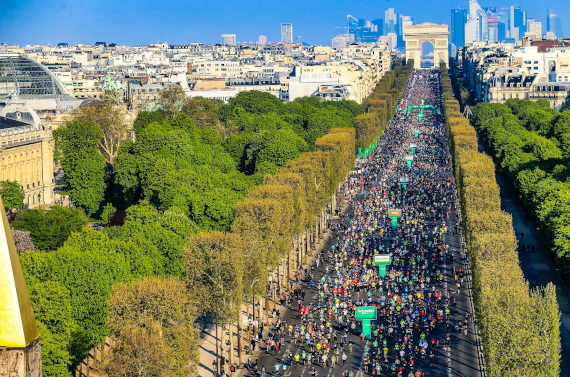
On Sunday 14 April, more than 50,000 runners took to the streets of the French capital to take part in one of the world’s largest races, the Paris Marathon. The iconic course winds through the heart of the city, taking runners past landmarks such as the Louvre, the Bastille, the Eiffel Tower and along the Seine.
This year‘s edition however, drew attention for the organisers’ controversial decision to remove disposable cups entirely from aid stations. Instead, runners were encouraged to arrive prepared with flasks, reusable cups, or hydration vests, refilling at water stations fitted with taps and hoses. It was a bold operational move, but one that has drawn significant criticism so it’s worth examining the advantages and drawbacks of the decision.
As race directors, we are aware how global warming is starting to affect our events. With heat levels climbing, optimal racing windows have become narrower and it is necessary to future proof our races. With this in mind, the sustainability of our events is key to the fight against climate change. Reducing single-use plastic or other items seems like a great way to start.
This was probably the thinking behind the Paris Marathon organisers’ decision to eliminate disposable cups as part of a sustainability drive but in the broader context, did the environmental benefit truly outweigh the impact on runners?
According to Marathon Handbook, by removing disposable cups, the race cuts approximately 15 tonnes of carbon dioxide equivalent (CO₂e) - a standard measure of climate impact - roughly comparable to eliminating a return flight between London and Paris carrying 75 passengers.
But how does that stack up against the event’s overall footprint? The London Marathon, a race of similar scale, reported total emissions of 54,300 tonnes of CO₂e in 2023. If Paris is in the same range, cutting out paper cups reduces the total footprint by just 0.027%. In other words, a marginal gain at best.
And what was the impact on the runners? The most common complaints were:
• Time lost while stopping to refill
• Difficulty filling narrow flasks efficiently
• Water pressure inconsistencies (spray vs flow)
• Break in rhythm, especially for performance-focused runners
Elite athletes were largely unaffected as they received a special bottle service from the race, while back-of-the-pack competitors were generally positive as they are more comfortable taking their time to refill bottles, and recover.
The impact was felt mostly by mid-pack runners, the largest and most engaged group, who dislike disruptions in pace without clear benefit. They were frustrated by the difficulty filling narrow flasks and having to potentially jeopardise their race by waiting in line for refills.
There is also a legitimate concern that athletes, in an effort to save time, may not hydrate adequately, potentially leading to serious health risks.
From my perspective, sustainability measures should be pursued as far as possible, right up to the point where they begin to compromise the race experience itself. As much as the Paris Marathon’s bold move is admirable, it might have been a little premature.
There is already encouraging innovations, including biodegradable water pearls that runners can consume and dispose of safely without environmental impact. The focus should be on advancing and adopting solutions like these, rather than removing essential elements of the race in ways that detract from the athletes’ experience.
What do you need help with as an event organiser? If there is an area of organising you would like to know more about, send a mail to tim@finishtime.co.za and we will see if we can find some info for you.
|